FTSE Reverses into the Red Near Six-Week Lows
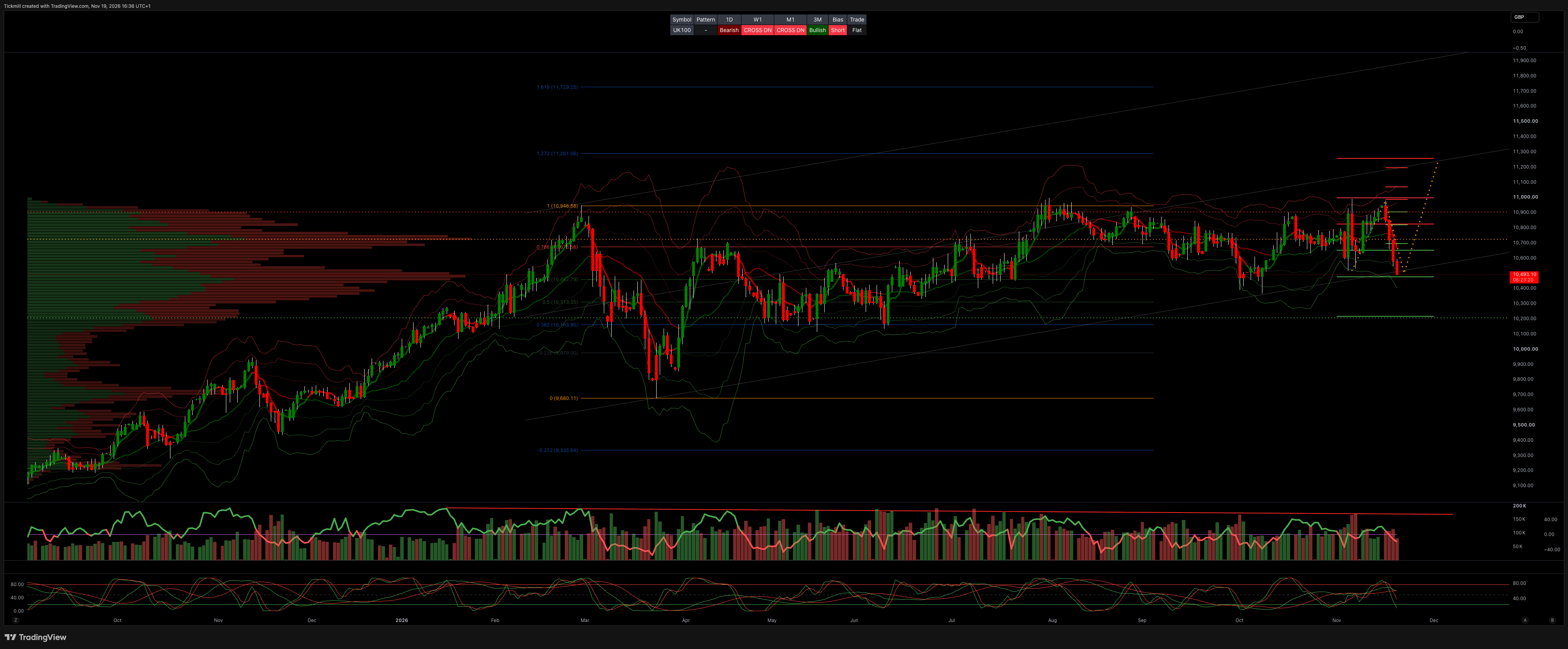
FTSE Reverses into the Red Near Six-Week Lows
London's benchmark FTSE 100 surrendered an early advance to reverse into negative territory on Thursday, sliding 74.90 points or 0.71% to trade at 10,505.60 near the bottom of its intraday range and hovering close to six-week lows. While major continental European indexes drew support from global tech optimism surrounding Anthropic's record IPO, U.K. equities diverged lower as stock-specific earnings reactions across consumer, financial, and defensive utility heavyweights weighed heavily on top-flight performance.
Consumer staples, retail, utilities, and select financials bore the brunt of the market downturn. Financial services group Investec tumbled 6.6% after flagging weaker momentum across its U.K. operations, while sportswear retailer JD Sports Fashion dropped roughly 4.2% after trimming the top end of its full-year profit guidance. Broad selling between 2% and 3% hit Vodafone Group, National Grid, Imperial Brands, Severn Trent, Reckitt Benckiser, Unilever, 3i Group, and Coca-Cola Europacific Partners. Notable downside pressure also extended across British American Tobacco, United Utilities, Experian, ConvaTec Group, British Land, Admiral Group, Tesco, GSK, Diageo, and Associated British Foods. Outside the main benchmark, luxury leather goods maker Mulberry Group tanked 22% after posting a half-year pre-tax loss of £33.4 million for the 26 weeks ended September 26, despite progress on its operational turnaround.
Conversely, defense engineering, industrial technology, and resource producers delivered bright spots against the broader sell-off. Babcock International soared 8% to top the FTSE 100 after reporting a 13% rise in first-half underlying operating profit and upgrading its full-year guidance. Safety and technology group Halma climbed 3.7% after lifting half-year net profit to £219.9 million (£0.5802 per share vs. £186.8 million prior year), while specialty chemicals producer Johnson Matthey gained over 2% after raising its full-year profit outlook on robust interim results. Natural resource heavyweights bounced back from recent weakness, with Anglo American Plc rising 2.7%, Antofagasta gaining 2.3%, Glencore adding 1.7%, and Fresnillo advancing 1.5%. Tech-exposed Polar Capital Technology Trust climbed 3.5% and luxury peer Burberry Group rose 3.2%, while solid gains of 2% to 3% lifted Computacenter, Pershing Square Holdings, IMI, Rolls-Royce Holdings, and Smiths Group. Melrose Industries, Barclays, Airtel Africa, Games Workshop, and Spirax Group also recorded notable advances.
On the domestic macroeconomic and central bank front, survey data pointed to a nascent recovery in industrial activity. The Confederation of British Industry (CBI) Industrial Trends Survey showed notable improvements in U.K. manufacturing orders in November, with the total order balance rising to -12% from -32% in October and export orders strengthening to -19% from -25%. Crucially, quarterly output volumes expanded for the first time since May 2024, posting +9% in the three months to November compared to -10% previously. Meanwhile, speaking on an IMF panel, Bank of England Deputy Governor Clare Lombardelli emphasized that long-term inflation expectations have remained well-anchored despite recent supply shocks—demonstrating the credibility of the inflation framework—while noting former Fed Chair Ben Bernanke's advice to avoid tying policy outlooks to any single economic variable amid heightened uncertainty.
In U.K. fixed-income and money markets, structural liquidity dynamics in low-coupon Gilts are drawing heightened desk scrutiny. As successive deeply discounted bonds approach maturity, the pool of low-coupon Gilts—favored by tax-sensitive domestic private investors for their split between taxable income and tax-exempt capital gains—is set to narrow materially. Redemptions trigger mechanical, one-way rotations into the next low-coupon issue up the curve, causing those bonds to richen in cash and grow scarce in repo markets, as recently seen in 0E28s where repo specialness neared the effective cap set by the BoE's Standing Repo Facility. With fewer issues left to absorb rolling demand, Debt Management Office (DMO) supply decisions and tax treatment will remain critical in gauging the risk of acute cash and repo squeezes.
Finish Line: U.K. equities failed to sustain an early rebound, diverging from European peers as guidance cuts at JD Sports, operational softness at Investec, and broad defensive utility selling pulled the FTSE 100 down toward the 10,500 threshold. While standout profit upgrades from Babcock International, Halma, and Johnson Matthey alongside improving CBI factory orders underscored pockets of industrial resilience, heavy index concentration in lagging consumer staples kept London on the back foot.
Disclaimer: The material provided is for information purposes only and should not be considered as investment advice. The views, information, or opinions expressed in the text belong solely to the author, and not to the author’s employer, organization, committee or other group or individual or company.
Past performance is not indicative of future results.
High Risk Warning: CFDs are complex instruments and come with a high risk of losing money rapidly due to leverage. 68% and 74% of retail investor accounts lose money when trading CFDs with Tickmill UK Ltd and Tickmill Europe Ltd respectively. You should consider whether you understand how CFDs work and whether you can afford to take the high risk of losing your money.
Futures and Options: Trading futures and options on margin carries a high degree of risk and may result in losses exceeding your initial investment. These products are not suitable for all investors. Ensure you fully understand the risks and take appropriate care to manage your risk.
Patrick has been involved in the financial markets for well over a decade as a self-educated professional trader and money manager. Flitting between the roles of market commentator, analyst and mentor, Patrick has improved the technical skills and psychological stance of literally hundreds of traders – coaching them to become savvy market operators!