FTSE Finish Line: July 20 — FTSE Slips as Brent Tops $90 and Burnham Enters Downing Street
FTSE Finish Line: July 20 — FTSE Slips as Brent Tops $90 and Burnham Enters Downing Street
London edged lower on Monday as the FTSE 100 struggled against a renewed oil shock, rising shipping fears around the Strait of Hormuz and uncertainty over the policy direction of Britain’s new prime minister, Andy Burnham. The index was not sharply weaker, but the tone was defensive as investors marked the start of a politically significant week while also confronting a worsening Middle East conflict. The immediate market pressure came from energy and shipping risk. U.S. strikes on Iran entered a ninth straight day, and concerns over the Strait of Hormuz intensified after reports of tankers being immobilised. Brent crude rose above $90 a barrel for the first time in a month, bringing inflation anxiety back into focus and reviving worries that higher fuel and freight costs could squeeze companies and households. That backdrop weighed most heavily on energy-price-sensitive sectors. Automobiles fell 1%, while travel and leisure lost 0.7%. The logic was straightforward: higher oil increases operating costs, raises fuel and transport expenses, and threatens discretionary demand if consumers are forced to absorb another energy-driven hit to real incomes. For airlines, hotels, leisure groups and consumer cyclical names, the Iran shock is increasingly being treated as both a cost shock and a demand shock. Ryanair underlined that pressure. The budget airline tumbled 7.2% after reporting a one-third drop in first-quarter profit and warning that summer ticket prices could come under pressure amid uncertainty over the Iran conflict and the broader economy. The update was a direct reminder that travel demand can look resilient until rising fuel costs, weaker consumer confidence and geopolitical disruptions start to compress margins and pricing power. Oil prices are back above $90 a barrel. That puts inflation fears back on the table, with major implications for interest-rate expectations. The comment fits the broader market setup: investors are no longer looking only at earnings or valuations but at the interaction between oil, inflation, Bank of England policy and the new government’s fiscal stance.
Gilts reflected that uncertainty, with British government bond yields edging higher as investors assessed the implications of a new Labour government for fiscal policy and public spending priorities. Burnham enters Downing Street promising to tackle living costs and struggling public services, but markets will want to see how those commitments are funded. The immediate question is not whether the new administration wants to support households and rebuild public capacity, but whether it can do so without unsettling the gilt market. The Chancellor appointment and early fiscal framework will therefore matter. After reports that Shabana Mahmood is likely to become Chancellor, investors will look for clarity on fiscal rules, departmental spending discipline, tax compliance, infrastructure investment and the sequencing of any structural reforms. The OBR’s long-term debt warnings, elevated borrowing costs and the £59.2 billion HMRC tax gap all frame the challenge. A credible plan to raise compliance and improve productivity could help, but markets will be wary of unfunded commitments. The Bank of England remains caught between two forces. On one side, Brent above $90 raises near-term headline inflation risk and complicates the path back to target. On the other, a sustained energy shock is likely to weaken demand in the UK because households and firms face higher essential costs. That makes the shock potentially inflationary in the short run but dovish over the medium term if it damages growth enough to pull inflation lower later. Recent comments from Deputy Governor Sarah Breeden remain highly relevant. Her focus is on how the energy price shock is being absorbed in the economy, and she has stressed that the BoE would act if inflation looked like becoming embedded. But she also noted that the UK has a softish economic outlook, making the energy shock less likely to require policymakers to lean aggressively against inflationary pressures. That supports the “active hold” framework: monitor carefully, keep expectations anchored, but avoid hiking unless second-round effects emerge.
There were some pockets of resilience. Technology stocks rose 0.5% to lead sectoral gains ahead of earnings from U.S. Big Tech companies, which will provide a fresh test of the AI-driven rally. The move suggested investors remain willing to hold exposure to global growth and AI-linked themes, even as domestic and energy-sensitive sectors struggle. However, technology strength was not enough to shift the broader FTSE tone meaningfully higher. Big Yellow fell 2% after the self-storage firm reported a decline in first-quarter occupancy rates. The move added to evidence that parts of the property and consumer-adjacent economy remain under pressure. Self-storage can be sensitive to housing turnover, business formation and household mobility, all of which are vulnerable when borrowing costs are high and consumers become more cautious.
The domestic data calendar now becomes critical. Tuesday brings public borrowing and labour-market data. The borrowing figures will be particularly important for the new administration because last month’s fiscal slippage reflected not only volatile inflation-indexed debt costs, but also a gradual increase in spending alongside slower revenue growth. Investors are likely to scrutinise the numbers through the lens of Burnham’s policy promises and the likely fiscal room available to the incoming Chancellor. The labour-market report may offer more reassurance to the Bank of England. Employment has shown signs of improvement, while wage pressures appear to be easing. That is close to the ideal configuration for monetary policy: strong enough to reduce concern over an abrupt growth slowdown, but not so tight that it forces the MPC to respond more aggressively to inflation. If wage growth continues to soften, the BoE can look through more of the energy shock unless it spills into expectations and services prices. Wednesday’s inflation report will also matter, though perhaps less than usual after two consecutive downside surprises and softer inflation readings from the U.S. and euro area. Lower energy prices through June are expected to pull headline and core CPI down from May’s 2.8% and 2.6% year-on-year rates. In normal conditions, an upside surprise would be more disruptive. But in the current environment, markets may be more forgiving if wages and services inflation do not reaccelerate. The week concludes with the CBI trends survey on Thursday, followed by retail sales and the BoE Decision Maker Panel on Friday. Retail sales will show whether consumers are still absorbing the upfront costs of the Iran shock by dipping into savings. That behaviour can support spending temporarily, as seen in the U.S., but it also means household balance sheets are bearing more of the pressure. The key question is whether retail resilience reflects genuine improvement or merely a delayed reaction to higher energy costs.
Finish Line: The FTSE 100 edged lower as Brent crude climbed above $90, U.S.-Iran strikes intensified and reports of immobilised tankers heightened fears over the Strait of Hormuz. Travel, leisure and autos weakened as fuel-cost and demand concerns grew, while Ryanair’s 7.2% fall showed how quickly the oil shock can hit earnings expectations. Technology offered some support ahead of U.S. Big Tech results, but gilts sold off modestly as investors assessed Burnham’s arrival in Downing Street and the fiscal implications of his agenda. This week’s borrowing, jobs, CPI, retail sales and BoE survey data will test whether the UK can maintain a soft-landing narrative while absorbing a renewed energy shock and a major political transition.
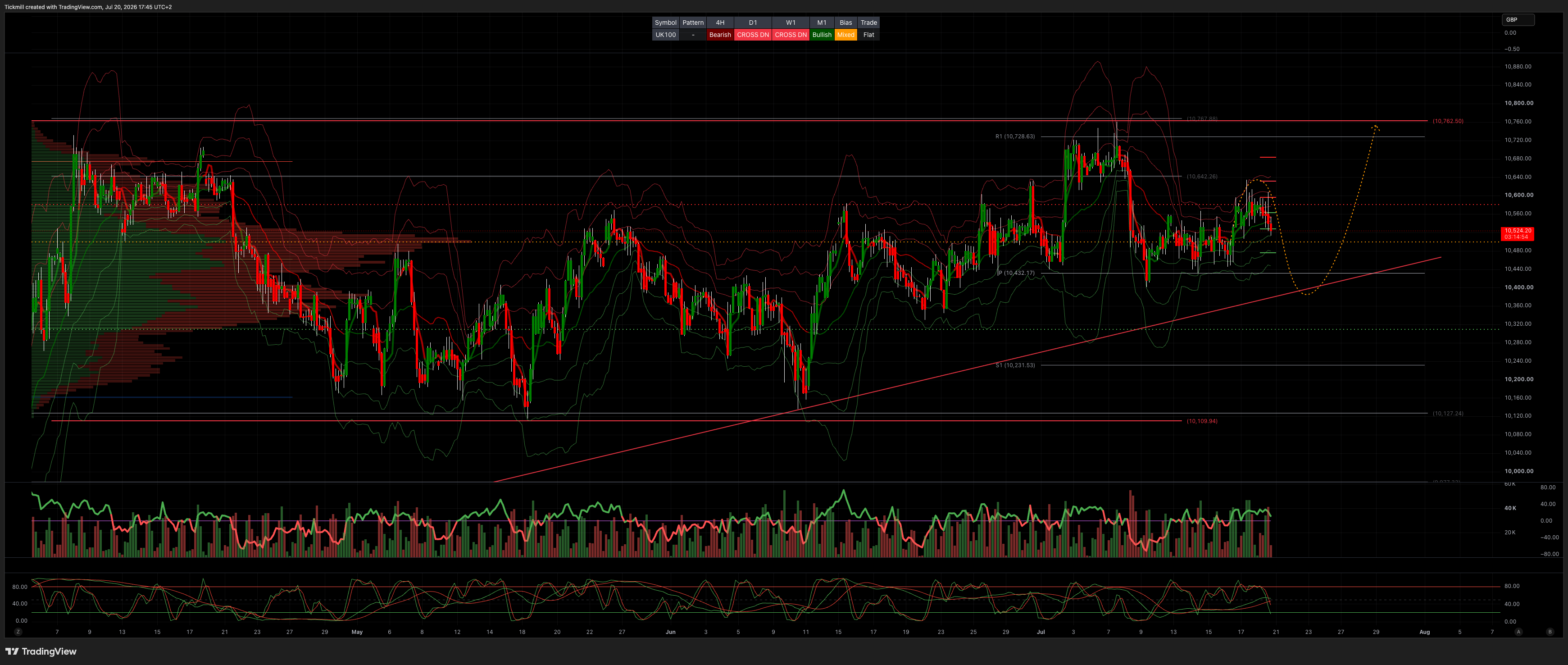
TECHNICAL & TRADE VIEW – FTSE100
Daily VWAP Bullish>Bearish
Weekly VWAP Bullish>Bearish
Above 10300 Target 11000
Below 10100 Target 9469
Disclaimer: The material provided is for information purposes only and should not be considered as investment advice. The views, information, or opinions expressed in the text belong solely to the author, and not to the author’s employer, organization, committee or other group or individual or company.
Past performance is not indicative of future results.
High Risk Warning: CFDs are complex instruments and come with a high risk of losing money rapidly due to leverage. 69% and 73% of retail investor accounts lose money when trading CFDs with Tickmill UK Ltd and Tickmill Europe Ltd respectively. You should consider whether you understand how CFDs work and whether you can afford to take the high risk of losing your money.
Futures and Options: Trading futures and options on margin carries a high degree of risk and may result in losses exceeding your initial investment. These products are not suitable for all investors. Ensure you fully understand the risks and take appropriate care to manage your risk.
Patrick has been involved in the financial markets for well over a decade as a self-educated professional trader and money manager. Flitting between the roles of market commentator, analyst and mentor, Patrick has improved the technical skills and psychological stance of literally hundreds of traders – coaching them to become savvy market operators!